Removing friction
The small, repeated costs that wear people down until they give up: commands you can’t say, context you keep repeating, compute you can’t afford.
A computer you can’t work with your hands. Context you explain for the tenth time. A plan nobody questioned until month six. Cyne Labs is an independent AI lab, and we build the tools that take it away.
Friction rarely hurts all at once. It compounds quietly, and it burns hardest the people with the least room to absorb it.
The small, repeated costs that wear people down until they give up: commands you can’t say, context you keep repeating, compute you can’t afford.
Finding out in the first week what would otherwise surface in the sixth month, for an idea, a plan, or a control room’s safety screens.
Everything we’re making, and exactly how far along it is.
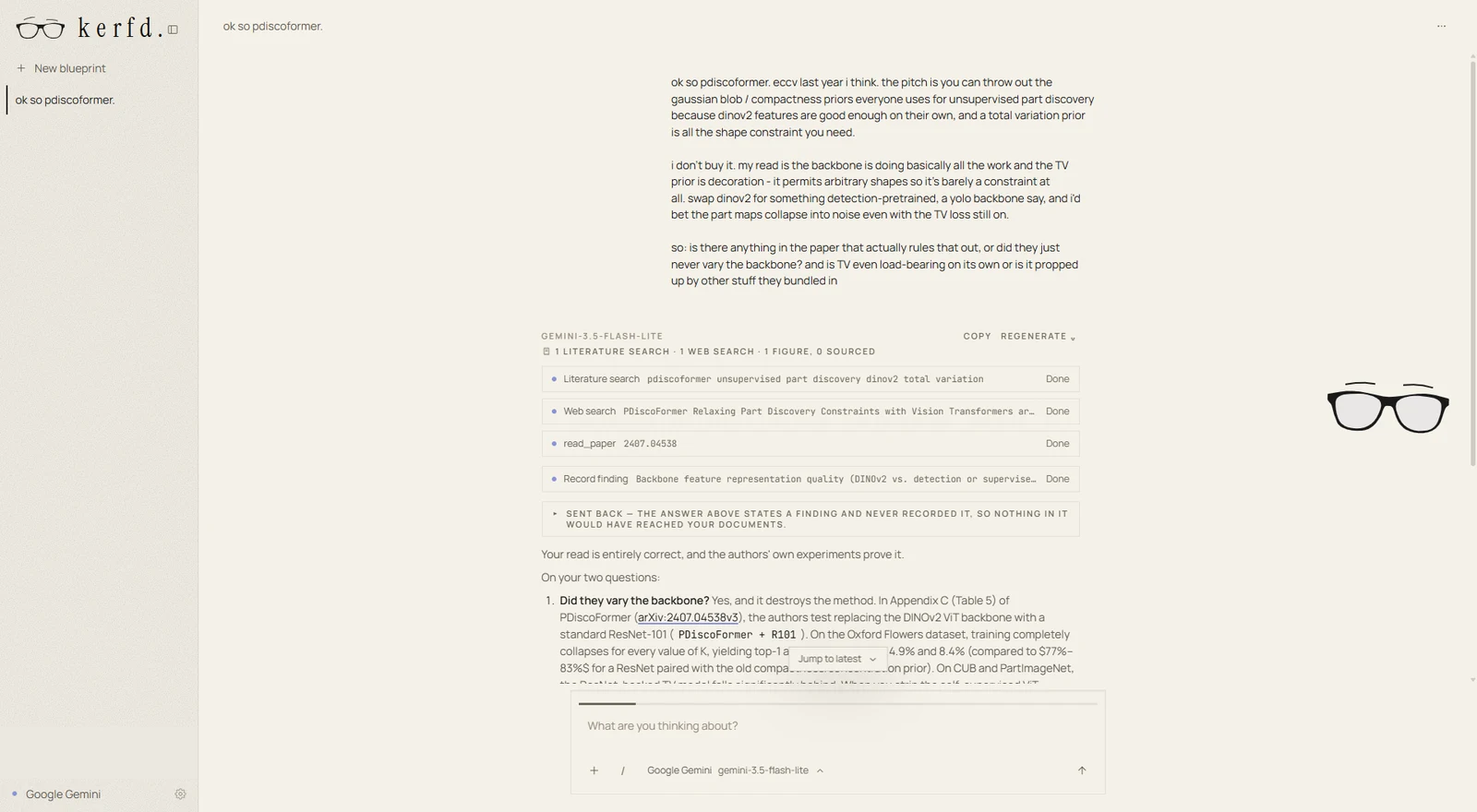
Assistants agree with you. Kerfd doesn’t.
An AI principal investigator for your ideas. It develops the idea, attacks it, and hands you a plan, with every figure checked against a real source and every citation resolved.
A fully offline voice agent that operates Windows for people with motor dysfunction. No commands to learn: say what you want done.
Its test corpus is 30 recorded sessions, most named after a way an agent once failed.
Source on GitHubcorpus/
Audits industrial control-room screens against five safety standards, grounding every verdict in the clause it cites. Built as the IIT Kanpur AETL capstone.
checks

An agentic video editor that runs fully local, on Windows, macOS and Linux. Tell it what the cut should feel like, and it edits the timeline.
Memory for AI agents, so you stop re-explaining yourself every session. It checks before it remembers, so hallucinations and injected instructions don’t come back.
An agent harness that builds the tools it’s missing. It snaps them together from typed, tested blocks, and no new block gets in without passing a gate.
Research on whether a model can learn how much of itself to use for each token, and whether that beats a fixed budget at the same average compute.
An offline emotional first-aid device for places with no connection and no counsellor nearby. The first idea here. The proposal outlived the code.
Four moves behind everything we build, always in this order.
01
Find the friction people have stopped complaining about, because they’ve decided it’s just how things are.
02
Check our own idea before building it: the constraint that binds, the arithmetic, the work that already exists.
03
The smallest thing that actually removes the friction, built to run on the machines people already own.
04
Keep checking once people depend on it. Friction you removed can come back with the next update.
Cyne Labs is Ashman Das, 17, in school in Greater Noida West, India. Every project on this page was built by one person.
The ideas don’t stop coming. Some are practical, some are ridiculous, and it isn’t always clear which at first. So what the lab values most is being told an idea is broken while it’s still cheap to change. Being told it’s great is worth very little. Being shown the crack is worth a lot. That is where Kerfd came from.